
HW-D-0390
October 19, 2015
October 19, 2015
Assembly Ratings — 1 and 2 Hr (See Item 2)
Nominal Joint Width - 1 In.
Class II Movement Capabilities - 12.5% Compression or Extension
L Rating At Ambient - Less Than 1 CFM/Lin Ft
L Rating At 400 F - Less Than 1 CFM/Lin Ft
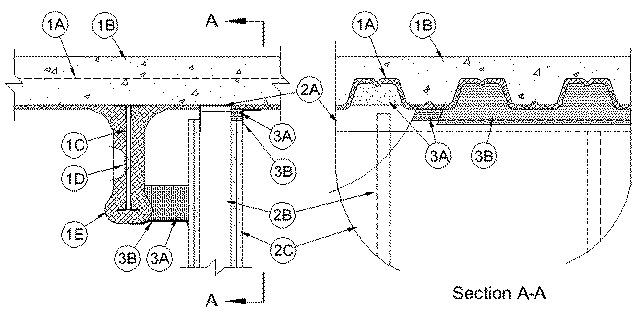
1.Floor Assembly — The fire-rated fluted steel deck/concrete floor assembly shall be constructed of the materials and in the manner described in the individual D700 or D900 Series Floor-Ceiling Design in the UL Fire Resistance Directory. The hourly fire rating of the floor assembly shall be equal to or greater than the hourly fire rating of the wall assembly. The floor assembly shall include the following construction features:
A.Steel Floor and Floor Units* — Max 3 in. (76 mm) deep galv steel fluted floor units.B.Concrete — Min 2-1/2 in. (64 mm) thick reinforced concrete, as measured from the top plane of the floor units.C.Structural Steel Support — Steel beam or open-web steel joist, as specified in the individual D700 or D900 Series Floor-Ceiling Design, used to support steel floor units. Structural steel support oriented parallel to and 1 to 6 in. (25 to 152 mm) from wall assembly.D.Steel Lath — When structural steel support (Item 1C) consists of open-web steel joists, 3/8 in. (10 mm) diamond mesh expanded steel lath having a nom weight of 1.7 to 3.4 lb per sq yd (0.9 to 1.8 kg/m2) shall be installed to completely cover one side of each joist which is located within 6 in. (152 mm) of wall assembly. The lath shall be secured with steel tie wire and shall be fully covered with spray applied fire resistive material.E.Spray-Applied Fire Resistive Material* — After installation of the ceiling runner (Item 2A), steel floor units and structural steel supports to be sprayed with the thickness of material specified in the individual D700 or D900 Series Design. The flutes of the steel floor units above the structural steel supports and above the ceiling runner (Item 2A) shall be filled with spray-applied fire resistive material. As an alternate, the spray-applied fire resistive material in the flutes above the ceiling runner may be applied to follow the contour of the steel floor units. Excess material shall be removed from the flanges of the ceiling runner beyond the required thickness of spray-applied fire resistive material on the steel floor units.
ISOLATEK INTERNATIONAL — Type 300
GCP APPLIED TECHNOLOGIES INC — Type MK-6/HY, MK-6/HY ES, MK-6s, RG
1A.Roof Assembly — (Not Shown) — As an alternate to the floor assembly (Item 1), a fire rated fluted steel deck roof assembly may be used. The roof assembly shall be constructed of the materials and in the manner described in the individual P700 or P900 Series Roof-Ceiling Design in the UL Fire Resistance Directory. The hourly fire rating of the roof assembly shall be equal to or greater than the hourly fire rating of the wall assembly. The roof assembly shall include the following construction features:
A.Steel Roof Deck — Max 3 in. (76 mm) deep galv steel fluted roof deck.B.Roof Insulation — For P700 Series Designs, min 3/4 in. (19 mm) thick Mineral and Fiber Board* insulation applied in one or more layers directly over steel roof deck or over gypsum board sheathing laid atop steel roof deck as specified in the individual design. For P900 Series Designs, min 2-1/4 in. thick poured insulating concrete, as measured from the top plane of the roof deck as specified in the individual design.C.Roof Covering* — Hot-mopped or cold-application materials compatible with mineral and fiber board insulation.D.Structural Steel Support — Steel beam or open-web steel joist, as specified in the individual P700 or P900 Series Roof-Ceiling Design, used to support steel floor units. Structural steel support oriented parallel to and min 2 in. (51 mm) to max 6 in. (152 mm) from wall assembly.E.Steel Lath — When structural steel support (Item 1D) consists of open-web steel joists, 3/8 in. (10 mm) diamond mesh expanded steel lath having a nom weight of 1.7 to 3.4 lb per sq yd (0.9 to 1.8 kg/m2) shall be installed to completely cover one side of each joist which is located within 6 in. (152 mm) of wall assembly. The lath shall be secured with steel tie wire and shall be fully covered with spray applied fire resistive material.F.Spray-Applied Fire Resistive Material* — After installation of the ceiling runner (Item 2A), steel roof deck and structural steel supports to be sprayed with a thickness of spray applied fire resistive material as specified in the individual P700 or P900 Series Roof-Ceiling design. The flutes of the steel deck above the structural steel supports and above the ceiling runner (Item 2A) shall be filled with spray-applied fire resistive material. As an alternate, the spray-applied fire resistive material in the flutes above the ceiling runner may be applied to follow the contour of the steel roof deck. Excess material shall be removed from the flanges of the ceiling runner beyond the required thickness of spray-applied fire resistive material on the steel roof deck.
ISOLATEK INTERNATIONAL — Type 300
GCP APPLIED TECHNOLOGIES INC — Type MK-6/HY, MK-6/HY ES, MK-6s, RG
2.Wall Assembly — The 1 or 2 hr fire-rated gypsum board/steel stud wall assembly shall be constructed of the materials and in the manner described in the individual U400 or V400 Series Wall or Partition Design in the UL Fire Resistance Directory and shall include the following construction features:
A.Steel Floor and Ceiling Runners — Floor and ceiling runners of wall assembly shall consist of galv steel channels sized to accommodate steel studs (Item 2B). Ceiling runner to be provided with min 1-1/4 in. (32 mm) to max 3 in. (76 mm) flanges. Ceiling runner is secured to steel floor units (Item 1A) with steel fasteners or welds spaced max 24 in. (610 mm) OC. Ceiling runner to be installed parallel with structural steel support and located such that a max clearance of 4 in. (102 mm) is present between the finished wall and the spray-applied fire resistive material at the lowest elevation of the structural steel support.A1.Light Gauge Framing* — Slotted Ceiling Runner — As an alternate to the ceiling runner in Item 2A, ceiling runner to consist of galv steel channel with slotted flanges sized to accommodate steel studs (Item 2B). Ceiling runner secured to valleys with steel fasteners spaced max 24 in. (610 mm) OC.
BRADY CONSTRUCTION INNOVATIONS INC, DBA SLIPTRACK SYSTEMS — SLP-TRKA2.Light Gauge Framing* — Clipped Ceiling Runner — As an alternate to the ceiling runner in Items 2A and 2A1, clipped runner to consist of galv steel channel with clips preformed in track flanges which positively engage the inside flange of the steel studs (Item 2B). Track sized to accommodate steel studs (Item 2B). Track flanges to be min 2-1/2 in. (64 mm). Clipped ceiling runner secured with steel fasteners spaced max 24 in. (610 mm) OC.
TOTAL STEEL SOLUTIONS L L C — Snap TrakB.Studs — Steel studs to be min 3-1/2 in. (89 mm) wide. Studs cut 1/2 in. to 3/4 in. (13 to 19 mm) less in length than assembly height with bottom nesting in and secured to floor runner. When slotted ceiling runner (Item 2A1) is used, steel studs secured to slotted ceiling runner with No. 8 by 1/2 (13 mm) long wafer head steel screws at midheight of slot on each side of wall. Studs to nest in ceiling runner without attachment.C.Gypsum Board* — Gypsum board sheets installed to a min total 5/8 in. (16 mm) or 1-1/4 in. (32 mm) thickness on each side of wall for 1 and 2 hr fire rated assemblies, respectively. Wall to be constructed as specified in the individual U400 or V400 Series Design in the UL Fire Resistance Directory except that a max 1 in. (25 mm) gap shall be maintained between the top of the gypsum board and the bottom plane of the spray applied fire resistive material on the steel deck on both sides of the wall assembly. When no spray-applied fire resistive material is used on the steel deck, a max 1 in. (25 mm) gap shall be maintained between the top of the gypsum board and the bottom plane of the steel deck. The screws attaching the gypsum board to the studs along the top of the wall shall be located 1 in. (25 mm) below the bottom of the ceiling runner. No gypsum board attachment screws shall be driven into the ceiling runner. Where the top of the wall assembly is inaccessible above the lowest elevation of the structural steel support, the gypsum board attachment screws may be omitted.The hourly fire rating of the joint system is equal to the hourly fire rating of the wall.
3.Joint System — Max separation between bottom plane of steel deck or spray-applied fire resistive material and top of gypsum board (at time of installation of joint system) is 1 in. (25 mm). Separation distance between spray applied fire resistive material on structural support member and surface of wall is min 1 in. (25 mm) to max 4 in. (102 mm). The joint system is designed to accommodate a max 12.5 percent compression or extension from its installed width as measured between the bottom plane of the steel deck or the spray-applied fire resistive material on the steel deck and the top of the gypsum board. The joint system shall consist of forming and fill materials, as follows:
A.Forming Material* — Nom 4 pcf (64 kg/m3) density mineral wool batt insulation. Sections of mineral wool batt cut to a width of 4 in. (102 mm) and stacked to attain a thickness which is 50 percent greater than the width of the linear gap between the spray applied fire resistive material on the structural steel member and the surface of the wall assembly. Stacked sections of mineral wool compressed 33 percent in thickness and installed cut edge first into linear gap until the bottom edge is flush with the bottom surface of the spray applied fire resistive material on the structural steel member. When no spray-applied fire resistive material is used on the steel deck or when the spray-applied fire resistive material in the flutes above the wall follows the contour of the steel deck, sections of mineral wool batt cut to the shape of the fluted deck and stacked to a min 6 in. (152 mm) thickness shall be installed in the flutes of the steel floor or roof deck between the top of the ceiling runner and the steel deck or spray-applied fire resistive material. The mineral wool batt insulation is to be installed flush with the gypsum board surface on the side of the wall opposite the structural steel support. Additional sections of mineral wool batt insulation are compressed 50 percent in thickness and are installed cut edge first to completely fill the gap above the top of the gypsum board.
INDUSTRIAL INSULATION GROUP L L C — MinWool-1200 Safing
JOHNS MANVILLE — Safing
ROCK WOOL MANUFACTURING CO — Delta Safing Board
ROCKWOOL MALAYSIA SDN BHD — SAFE
ROCKWOOL — SAFE
THERMAFIBER INC — SAFA1.Forming Material* - Plugs — (Not Shown) As an alternate to the forming material (Item 3A), mineral wool plugs preformed to the shape of the fluted floor units, may be used within the flutes. Plugs shall be friction fit to completely fill the flutes above the ceiling channel. The plugs shall project beyond each side of the ceiling runner, flush with wall surfaces. Additional forming material, described in Item 3A, to be used in conjunction with the plugs to fill the gap between the top of gypsum board and bottom of steel floor units or roof deck.
ROCK WOOL MANUFACTURING CO — Delta Deck PlugsB.Fill, Void or Cavity Material* — Sealant — Min 1/8 in. (3.2 mm) wet thickness or 1/16 in. (1.6 mm) dry thickness of fill material spray or brush applied over the forming material on each side of the wall. Fill material to overlap a min of 1/2 in. (13 mm) onto the gypsum board and a min of 2 in. (51 mm) onto the steel deck or the spray-applied fire resistive material on the steel deck and on the spray-applied fire resistive material on the structural steel support member on each side of the wall.
RECTORSEAL — FlameSafe FS3000, Metacaulk 1200, 1500 or Biostop 750, 800 Spray